![[personal profile]](https://www.dreamwidth.org/img/silk/identity/user.png)

As Terry Pratchett said, "In the beginning there was nothing, which exploded." This is exactly how many people see the Big Bang. However, there is a big difference between "nothing" in people's imaginations and "Nothing" that really exploded. And that’s what we are going to discuss now. What exploded and why? How did it happened that the explosion brought the entire Universe out of this Nothing? And how the heck it was packed into it? So, let's begin. We all know from school what atoms are. They are the little things that everything is made of. Once upon a time, a couple of ancient Greek philosophers, Leucippus and Democritus, noticed that linen laid out for drying actually dries. So, these ancient Greeks decided that the water consists of something very small and this small things gradually disappear. Of cause, this was noticed by everyone, especially the women, who actually laid out this linen for this exact purpose, but only those men decided to think about the nature of things while being engaged to such a boring activity. They called these little things atoms, which means indivisible. And they were wrong, but they did not know it and died happy that they penetrated the nature of things. So, they said, the world is made of tiny atoms and void.
Time has passed. Once upon a time, people discovered that the world is a little bit more complicated, and the indivisible atom turned out to be pretty much divisible. First, people discovered that the atom consists of two main things: a proton and an electron. The proton is positively charged particle, which is proudly located in the center of the atom, and the electron is negatively charged thing that flies around. And scientists decided that those are now the indivisible parts. A proton is such a big and heavy thing, and an electron has about 1000 times smaller mass. They were often depicted as one heavy ball in the center and another one in the circular orbit nearby. However, this was a picture of only the simplest hydrogen atom, which has only one proton and one electron, and the other atoms turned out to be even more complex; they have several protons in the center, and several electrons around, but still it was beautiful and clear picture, and the scientists calmed down: The world consists of protons, electrons and void.

However, this void turned out to be unexpectedly huge. If we consider the simplest hydrogen atom and imagine that it has become of a size of a... say giant wheel of the view, then the proton will be the size of a grape or a bead placed in the center, and the electron is orbiting the wheel. All the rest will be empty space. In case of other elements, like helium, oxygen, etc., we have several protons instead of one, which we can imagine as some beads glued together and located in the center of an atom. And the same amount of electrons would be circling around. All of them are located at different orbits, and these orbits are positioned further and further away from the core. And this distance is measured already in several wheel's radii or even in several dozen radii.
But the adventure of these little things is not over yet. First, scientists compiled a table of elements by the number of protons in the nucleus of atoms. It turned out that substances very much change their properties depending on this amount. The number of protons in the nucleus is equal to the number of orbiting electrons. But when people measures the mass of the nucleus they found out that the mass is too big for this arrangement. So, scientists decided that in addition to protons in the nucleus there is something else, some little thing that has mass but no charge. And it was it! People found a particle with the mass that is approximately equal to the proton mass, but neutral (with no charge). They called it a neutron for simplicity.
Along the way, it turned out that the proton is a very stable particle, one of the main elements of which the Universe is built of. Some of the protons that are inside our body or the body of our planet have existed right from the time of the Big Bang — billions of years. Do you feel it? Can you comprehend it? Oh, yeah! But what about neutrons? And it happen to be not very stable particle; it likes to fall apart. This process is called beta decay, when the neutron is divided into a proton and an electron. Well, plus something else, but we will leave it for now. Inside the nucleus of each element, they coexist very amicably — protons and neutrons — holding on tightly to each other and not wanting to split. And electrons (which also turned out to be very stable particles) fly around at a distance that we have already discussed.
And I must say that they fly on special orbits, which are not circular, they are spherical. Each electron has its personal orbit, and these orbits never intersect each other; they are located one inside the other as shells of the onion or as nesting dolls. And between them, there is a waste empty space. No electron can occupy the orbit, where another electron already dwells. Not allowed. This is Dr. Pauli's rule that is called the exclusion principle. It’s forbidden. And the electrons obey Dr. Pauli. For a while. But once upon a time…
But wait! First, let's travel a little deeper into the particles. Those protons and neutrons, which at first seemed to be the very indivisible particles, also turned out to be very divisible. They consist of quarks, three quarks in each neutron and each proton. Quarks are very fancy and diverse particles, and scientists suffered a lot, coming up with different names and colors, and other characteristics for them. But we don’t need it for now. The important thing is that now protons and neutrons also consist of some kind of quarks and void. And quite possibly this is not the limit of their division.
Phew... Let's make a break. Now we know that an indivisible atom is completely divisible, and even divisible into many parts.
Now let's imagine this: somewhere in the Universe some particles and atoms fly by close to each other and therefore they are attracted to each other. Gathering gradually in one big pile, they attract other particles and atoms to themselves, and now there are more and more of them. The more they gather to this heap, the more they attract others, etc. Time passes and a celestial body appears, which consists mainly of hydrogen and a small amount of other elements. And in this celestial body, the most densely populated place is the center. It becomes very crowded, and everything else presses down on this core. Like in the ocean, pressure increases with depth, so in gas formations. The higher the altitude, the thinner the atmosphere — like on Earth. And vice versa, the deeper inside —the substance becomes more thicker and dense.
Now imagine what happens in the depths of the Mariana Trench on Earth. The pressure there is so great that the submarine will be crushed like a shell. But an ordinary atom in this Mariana Trench feels quite good. However, imagine the depths of the ocean on the Sun or another star. Here, at the very depths, this atom feels uncomfortable. And what if the star mass is equal to several tens or hundreds of the mass of the Sun? The atoms inside in the depths are getting really bad. They barely hold that terrible weight, which puts pressure on them from above.
And once the atoms in the depths collapse!
At first (as supposed), the so-called inverse beta-decay occurs inside the star. As we recall, during beta decay, a neutron turns into a proton, electron, and something else. And during inverse beta decay, protons and electrons combine together to form a neutron. What happens during this process? If there is a distance similar to a wheel of view radius between an electron and a proton (on a comparative scale of an atom), then we can imagine how much void is squeezed out of the star (if you may say so)!
When a star that has a mass of, for example, tens of suns and millions of miles in its diameter, collapses into a neutron star, the mass of the new star remains almost the same except the mass of the stuff that flew away into the Universe during a collapse-explosion. However, the size of this new star will not be measured in millions or even thousands of miles. Its diameter will be say 12 miles.
But this is not the limit of compression. Because in some cases, the boundaries between the neutrons and protons also could fall down, and the star collapses to a quark star; and now it becomes even smaller in size, say 7 miles in diameter. 
Think this is the limit? Of course, not. After all, we know that there are also black holes — the so-called space objects, which could swallow the star with a mass from several tens to several millions of suns. Well, not exactly! It is not about a black hole with humongous appetite. This is not like a star is getting swallowed; the star is just getting self-packed into a black hole. The large star is converting and transforming into a black hole, which is the tiny cosmic object with huge mass and various miraculous features, which are not well studied yet.
And we can only imagine what microscopic elementary particle the atom is divided to, so that it can be packed so thoroughly that there will not be a millimeter of free space between these proto-particles. Not a micro-meter of emptiness. Not a nano-, pico-, femto-, atto-, zepto-, yocto-meter of emptiness. Nothing. We have reached the limit of fissility of an atom. We got the primary proto-sand and put everything in a proto-sandbox. The result was a cosmic body that has virtually no physical size. Wow! Is this thing could be called "nothing"? Is this really “nothing” if in mass it is equal to that same star with a mass of a million suns? What if several similar black holes merged together? And once upon a time, the entire Universe can be packed into such a cosmic object, which... Nevermind… Can you really imagine this mass? The mass of the whole Universe. How do you like this "Nothing"?
And if one day it explodes, there will be a new Big Bang, new stars and galaxies. And everything, the entire life of the entire Universe will start again…

Many years ago being a teenager, I saw one science fiction movie, where an allegedly black hole was shown. It looked more like a spectacular galaxy, and it was pretty funny to me: how can you see a black hole if the light cannot escape it? Much later, I realized that even though the image in the movie did not correspond to reality, and of course we can’t see the black hole, but still there are many interesting phenomena around we can see. So, what exactly can be observed?
First, imagine Saturn with its magnificent rings, and then imagine this Saturn turned black, and you cannot see the planet itself, but still can see the rings, and you get the picture. There are sparkling rings that circle around something we cannot actually observe, but it is there. The 'invisible' Saturn represents the event horizon of a black hole; we cannot see anything beyond this point. And the ring-like thin and hot shining structures formed of matter attracted by a black hole is so called an accretion disk. This disk is located on the equatorial plane as in any other galaxy formed around any massive celestial body. These rings are not calm rings made of ice chunks slowly circling around our well-familiar gas giant Saturn. This matter consists of highly energetic plasma that could be accelerated up to almost speed of light; it can be dense and heated if located close to the event horizon and it is more rarefied and slower moving at a distance. The accretion disk can also be visualized as a whirlpool, the very fast one.
There is a great NASA visualization that simulates the appearance of a black hole. (Figure 1)

https://www.nasa.gov/feature/goddard/2019/nasa-visualization-shows-a-black-hole-s-warped-world
However, as you can see in the picture, the accretion disk doesn't look like the Saturn rings. It is very deformed; it looks more like a weird emoticon without a face, but with a hat on. Some viewers have probably seen it in the Interstellar movie. Why do we see it this way? Because the space is very distorted, so the part of the ring, which is actually located behind this celestial body, would be seen partly over the top of the black hole horizon and partly below the bottom. So, the image is still like the rings of Saturn, as would be distorted in a curved mirror or rather seen through a strong convex lens or a clear glass sphere.
Yes, we get it; the space is distorted. But still… Do we? Why the disk has such a weird shape?
To understand the simplicity and beauty of this phenomenon, we need to understand the gravitational lens effect. Let's see the visualization. The image shows a computer model of the passage of a black hole. On the background, we can see the image of a distant galaxy. Note that the galaxy itself is not affected, it is far-far away, and nothing happens to it. Only its image is distorted. You can create alike effect using a strong convex lens or a glass sphere looking through to the image of the same galaxy or to any other image or geometric pattern. If you have such a lens or a glass sphere, then try it. This is the simplest experiment to help yourself to understand the phenomenon of gravitational lens, and you can do it at home. (Figure 2)
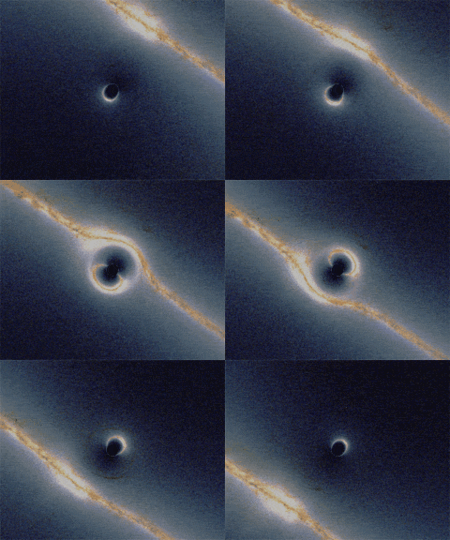
If we could move fast from say the southern pole of the black hole horizon toward the north pole (on Figure 1), we would observe about the same picture, as in the model above (Figure 2). The part of the accretion disk closer to us would look just like Saturn's rings, while the beyond horizon part would look like through the lens. So the difficulty to understand the shape of the disk is only due to the static state of the observer. If we could see it in dynamics, we would immediately recognize the phenomenon. Just watch the video!
https://www.youtube.com/watch?v=o-Psuz7u5OI
Moreover, the ability to see such images in dynamics also allows us to discover the new black holes and invisible massive bodies in the Universe. As soon as an astronomer notices that a whole sector of a previously familiar sky picture behaves somewhat weird like if seeing through a magnifying glass, e.g. some stars move up, others down, or even weirder: one star appears in several places (so called the Einstein cross), then this is a definite sign that an invisible very dark but massive object is moving between this familiar background picture and the observer. This unknown object distorts the background image. Recently, it was announced that in our slightly studied Solar system, presence of such an object was suspected somewhere behind Neptune. Thanks to the microlensing effect observed in this area (six events were counted), scientists suggested the presence of an exotic object that is still unidentified, and this could be either a large wandering planet or even primary black hole that formed from superdense matter at the time the expansion of the Universe began [What if Planet 9 is a Primordial Black Hole? Jakub Scholtz, James Unwin].
By the way, the effect of a cosmic lens was discovered by Einstein and was brilliantly proven during a solar eclipse at the beginning of the last century, when the light from a star passing near the Sun got deviated from its original direction flowing around the Sun, and the stars turned out to be visible not at the places, where they should be, but at a larger distance from the Sun.
So, observe the starry sky! It may be possible to notice the unusual behavior of the starry background and from this behavior you can discover new objects that have not been seen before. True, it would take a long time to discover that.
Also, if you have not seen the Interstellar movie, I highly recommend it. A group of scientists took part in its producing; and Kip Thorne even wrote a great book, The Science of Interstellar, where he described how they agreed to create images and visualizations that are as close as possible to what actually is known to science. Or at least they decided to use realistic scientific hypotheses. He explains the underlying science in details and yet simple enough for non-scientists. Therefore, to create a realistic image of a black hole or rather its surroundings, they used some real scientific working models; and the images were created accordingly to the latest scientific knowledge. And the recent real photo of a black hole proved it.

And finally, it is great to have an Internet and youtube, where we can find and enjoy so many great videos and visualizations!
youtu.be/_NgBE1pMRJM
First, imagine Saturn with its magnificent rings, and then imagine this Saturn turned black, and you cannot see the planet itself, but still can see the rings, and you get the picture. There are sparkling rings that circle around something we cannot actually observe, but it is there. The 'invisible' Saturn represents the event horizon of a black hole; we cannot see anything beyond this point. And the ring-like thin and hot shining structures formed of matter attracted by a black hole is so called an accretion disk. This disk is located on the equatorial plane as in any other galaxy formed around any massive celestial body. These rings are not calm rings made of ice chunks slowly circling around our well-familiar gas giant Saturn. This matter consists of highly energetic plasma that could be accelerated up to almost speed of light; it can be dense and heated if located close to the event horizon and it is more rarefied and slower moving at a distance. The accretion disk can also be visualized as a whirlpool, the very fast one.
There is a great NASA visualization that simulates the appearance of a black hole. (Figure 1)
https://www.nasa.gov/feature/goddard/2019/nasa-visualization-shows-a-black-hole-s-warped-world
However, as you can see in the picture, the accretion disk doesn't look like the Saturn rings. It is very deformed; it looks more like a weird emoticon without a face, but with a hat on. Some viewers have probably seen it in the Interstellar movie. Why do we see it this way? Because the space is very distorted, so the part of the ring, which is actually located behind this celestial body, would be seen partly over the top of the black hole horizon and partly below the bottom. So, the image is still like the rings of Saturn, as would be distorted in a curved mirror or rather seen through a strong convex lens or a clear glass sphere.
Yes, we get it; the space is distorted. But still… Do we? Why the disk has such a weird shape?
To understand the simplicity and beauty of this phenomenon, we need to understand the gravitational lens effect. Let's see the visualization. The image shows a computer model of the passage of a black hole. On the background, we can see the image of a distant galaxy. Note that the galaxy itself is not affected, it is far-far away, and nothing happens to it. Only its image is distorted. You can create alike effect using a strong convex lens or a glass sphere looking through to the image of the same galaxy or to any other image or geometric pattern. If you have such a lens or a glass sphere, then try it. This is the simplest experiment to help yourself to understand the phenomenon of gravitational lens, and you can do it at home. (Figure 2)
If we could move fast from say the southern pole of the black hole horizon toward the north pole (on Figure 1), we would observe about the same picture, as in the model above (Figure 2). The part of the accretion disk closer to us would look just like Saturn's rings, while the beyond horizon part would look like through the lens. So the difficulty to understand the shape of the disk is only due to the static state of the observer. If we could see it in dynamics, we would immediately recognize the phenomenon. Just watch the video!
https://www.youtube.com/watch?v=o-Psuz7u5OI
Moreover, the ability to see such images in dynamics also allows us to discover the new black holes and invisible massive bodies in the Universe. As soon as an astronomer notices that a whole sector of a previously familiar sky picture behaves somewhat weird like if seeing through a magnifying glass, e.g. some stars move up, others down, or even weirder: one star appears in several places (so called the Einstein cross), then this is a definite sign that an invisible very dark but massive object is moving between this familiar background picture and the observer. This unknown object distorts the background image. Recently, it was announced that in our slightly studied Solar system, presence of such an object was suspected somewhere behind Neptune. Thanks to the microlensing effect observed in this area (six events were counted), scientists suggested the presence of an exotic object that is still unidentified, and this could be either a large wandering planet or even primary black hole that formed from superdense matter at the time the expansion of the Universe began [What if Planet 9 is a Primordial Black Hole? Jakub Scholtz, James Unwin].
By the way, the effect of a cosmic lens was discovered by Einstein and was brilliantly proven during a solar eclipse at the beginning of the last century, when the light from a star passing near the Sun got deviated from its original direction flowing around the Sun, and the stars turned out to be visible not at the places, where they should be, but at a larger distance from the Sun.
So, observe the starry sky! It may be possible to notice the unusual behavior of the starry background and from this behavior you can discover new objects that have not been seen before. True, it would take a long time to discover that.
Also, if you have not seen the Interstellar movie, I highly recommend it. A group of scientists took part in its producing; and Kip Thorne even wrote a great book, The Science of Interstellar, where he described how they agreed to create images and visualizations that are as close as possible to what actually is known to science. Or at least they decided to use realistic scientific hypotheses. He explains the underlying science in details and yet simple enough for non-scientists. Therefore, to create a realistic image of a black hole or rather its surroundings, they used some real scientific working models; and the images were created accordingly to the latest scientific knowledge. And the recent real photo of a black hole proved it.
And finally, it is great to have an Internet and youtube, where we can find and enjoy so many great videos and visualizations!
youtu.be/_NgBE1pMRJM
Сферический идиот
May. 25th, 2015 05:48 pmСферический идиот это тот, кто выглядит идиотом с любой стороны. (закон Цвикки)
Вот вам и сферическая лошадь! Фраза-то оказывается имеет корни! Из книги "Охотники за нейтрино" Джея Райавардана: “Unlike his colleague, Zwicky was cranky and overbearing, and was fond of disparaging his enemies as “spherical bastards” (spherical, he said, because they looked like bastards from every angle).”
У Цвикки (американский астроном) был сварливый характер, и он любил называть своих врагов "сферическими выродками", потому что они выглядят выродками с любой стороны.
Вот вам и сферическая лошадь! Фраза-то оказывается имеет корни! Из книги "Охотники за нейтрино" Джея Райавардана: “Unlike his colleague, Zwicky was cranky and overbearing, and was fond of disparaging his enemies as “spherical bastards” (spherical, he said, because they looked like bastards from every angle).”
У Цвикки (американский астроном) был сварливый характер, и он любил называть своих врагов "сферическими выродками", потому что они выглядят выродками с любой стороны.
Чистая длясебятина
Feb. 5th, 2015 07:02 pmhttp://ocw.mit.edu/courses/mechanical-engineering/2-29-numerical-fluid-mechanics-fall-2011/lecture-notes/
http://www.space.dtu.dk/english/Research/Scientific_data_and_models/Magnetic_Ground_Stations/dtu_data_policies
http://www.space.dtu.dk/english/Research/Scientific_data_and_models/Magnetic_Ground_Stations
http://cdaweb.sci.gsfc.nasa.gov/cdaweb/sp_phys/
ftp://spdf.gsfc.nasa.gov/pub/data/
http://omniweb.sci.gsfc.nasa.gov/ftpbrowser/
http://spidr.ngdc.noaa.gov/spidr/dataset.do?view=geomagnetic
http://wdc.kugi.kyoto-u.ac.jp/
http://wdc.kugi.kyoto-u.ac.jp/hyplt/index.html
http://omniweb.gsfc.nasa.gov/form/dx2.html
http://www.space.dtu.dk/english/Research/Scientific_data_and_models/Magnetic_Ground_Stations/dtu_data_policies
http://www.space.dtu.dk/english/Research/Scientific_data_and_models/Magnetic_Ground_Stations
http://cdaweb.sci.gsfc.nasa.gov/cdaweb/sp_phys/
ftp://spdf.gsfc.nasa.gov/pub/data/
http://omniweb.sci.gsfc.nasa.gov/ftpbrowser/
http://spidr.ngdc.noaa.gov/spidr/dataset.do?view=geomagnetic
http://wdc.kugi.kyoto-u.ac.jp/
http://wdc.kugi.kyoto-u.ac.jp/hyplt/index.html
http://omniweb.gsfc.nasa.gov/form/dx2.html
Завернули статью
Dec. 29th, 2014 11:09 pmПослала статью в журнал, но ее не приняли. Сидим и обсуждаем с дм, что можно сделать. Поскольку оба рецензента прицепились к одному параметру, я решила поменять этот параметр в программе и прорешать все снова. Буду искать подходящий параметр перебором. Муж говорит, что надо сначала представлять, что получится, а потом делать. Отвечаю, "это потому что ты умный, а я программист"...
Насколько все же проще десять раз подпрыгнуть, чем один подумать. Наверное не получится из меня настоящего ученого...
Насколько все же проще десять раз подпрыгнуть, чем один подумать. Наверное не получится из меня настоящего ученого...
Interstellar
Nov. 13th, 2014 07:54 pmСходила в кино (в кои то веки!). Сообщаю впечатления. Но начну с воспоминаний.
Во времена оные, про которые рассказывать не люблю (ибо каждый раз меня посещает мысль типа "ой, какая я старая"), когда компьютерные игры (да и сами персональные компьютеры) только-только входили в обиход, появилась какая-то игра, которая изображала то ли бой самолетов, то ли бомбежку с боем, и был у меня приятель (по кличке Покрышкин), который служил когда-то пилотом, потому тема была ему не чужда. И очень он той игрой восхищался - "Представляешь", - говорил он выпучивая глаза и потрясая руками перед собой, - "все как в жизни! Вышел на курс - и летишь полчаса-час до цели!"
Второе воспоминание касается одного из совещаний отдела (наши еженедельные понедельниковые посиделки с прокруткой отдельских новостей; этакая пятиминутка размером в час). И запомнилось мне как кто-то посетовал, что государство и всякие гранто-дающие организации очень не любят спонсировать глубоко научные темы и что-то там реальное в ближнем космосе, а предпочитает что-нибудь более "секси" - например черные дыры и всякую другую экзотику, про что народ читает / смотрит с большим удовольствием. (Кстати поздравляю европейских коллег c замечательной посадкой робота на комету!)
Ну так вот про "секси" в науке и космосе и про долгие полеты. Говорят, что этот фильм консультировал NASA scientist. Может быть, может быть, только будучи и сама... как-то не чужда этой конторе, могу сказать, что временные скобки в реальности - это годы и десятилетия, но даже лучшие консультанты идут на поводу у зрительности, и полеты конечно делают короткими - раз! и долетели! раз! и уже в другой галактике! Ну понятно же - другие измерения и wormholes! И горючего на все хватило. Если сделать, как в реальности, то не будет "секси", и никто не пойдет смотреть (только может быть пилоты). Людям надо все в размере человеческой жизни, и чем быстрее, тем лучше. Потому временной режим фильма более напоминает мультик "Тайна третьей планеты". Так что наукой в кино не грузят, от нее отступают легко и элегантно.
Хотя в качестве полета фантазии (если забыть про физику), то фильм очень хороший и с хорошим актером (остальной состав там очень уж схематичен и выполнен по голливудским клише). Компьютерная графика могла бы быть покачественнее, хотя в реальности космос куда более пустой. Но да-да, я понимаю, надо "секси"... Планеты выполнены хорошо; очень понравилась первая. Только ее смотреть надо обязательно в кинотеатре.
Та часть фильма, которая совсем оторвана от реальности (не буду спойлить), в общем не раздражает, а скорее становится поэтическим отступлением. И к счастью актер ее вытягивает. Один знакомый (тоже кстати NASA scientist) даже увидел в этом налет кино Тарковского. На мое мнение - конечно не Тарковский, но все же для Голливуда это очень даже неплохо.
Безусловно фильм стОит посмотреть. Очень рекомендую! Здесь трейлер
*
Во времена оные, про которые рассказывать не люблю (ибо каждый раз меня посещает мысль типа "ой, какая я старая"), когда компьютерные игры (да и сами персональные компьютеры) только-только входили в обиход, появилась какая-то игра, которая изображала то ли бой самолетов, то ли бомбежку с боем, и был у меня приятель (по кличке Покрышкин), который служил когда-то пилотом, потому тема была ему не чужда. И очень он той игрой восхищался - "Представляешь", - говорил он выпучивая глаза и потрясая руками перед собой, - "все как в жизни! Вышел на курс - и летишь полчаса-час до цели!"
Второе воспоминание касается одного из совещаний отдела (наши еженедельные понедельниковые посиделки с прокруткой отдельских новостей; этакая пятиминутка размером в час). И запомнилось мне как кто-то посетовал, что государство и всякие гранто-дающие организации очень не любят спонсировать глубоко научные темы и что-то там реальное в ближнем космосе, а предпочитает что-нибудь более "секси" - например черные дыры и всякую другую экзотику, про что народ читает / смотрит с большим удовольствием. (Кстати поздравляю европейских коллег c замечательной посадкой робота на комету!)
Ну так вот про "секси" в науке и космосе и про долгие полеты. Говорят, что этот фильм консультировал NASA scientist. Может быть, может быть, только будучи и сама... как-то не чужда этой конторе, могу сказать, что временные скобки в реальности - это годы и десятилетия, но даже лучшие консультанты идут на поводу у зрительности, и полеты конечно делают короткими - раз! и долетели! раз! и уже в другой галактике! Ну понятно же - другие измерения и wormholes! И горючего на все хватило. Если сделать, как в реальности, то не будет "секси", и никто не пойдет смотреть (только может быть пилоты). Людям надо все в размере человеческой жизни, и чем быстрее, тем лучше. Потому временной режим фильма более напоминает мультик "Тайна третьей планеты". Так что наукой в кино не грузят, от нее отступают легко и элегантно.
Хотя в качестве полета фантазии (если забыть про физику), то фильм очень хороший и с хорошим актером (остальной состав там очень уж схематичен и выполнен по голливудским клише). Компьютерная графика могла бы быть покачественнее, хотя в реальности космос куда более пустой. Но да-да, я понимаю, надо "секси"... Планеты выполнены хорошо; очень понравилась первая. Только ее смотреть надо обязательно в кинотеатре.
Та часть фильма, которая совсем оторвана от реальности (не буду спойлить), в общем не раздражает, а скорее становится поэтическим отступлением. И к счастью актер ее вытягивает. Один знакомый (тоже кстати NASA scientist) даже увидел в этом налет кино Тарковского. На мое мнение - конечно не Тарковский, но все же для Голливуда это очень даже неплохо.
Безусловно фильм стОит посмотреть. Очень рекомендую! Здесь трейлер
*
В далекие времена...
May. 28th, 2014 03:58 pmВ давние стародавние времена (году так наверное в 1972-м) в школе был у нас преподаватель физики, скажем Евгений Иванович. И был урок оптики, где демонстрировал он нам законы отражения и преломления. Для демонстрации был такой приборчик - диск со шкалой, но проблема в том, что луч выглядит ярким на картинке, но не в жизни. И тогда наш героический учитель доставал сигареты и закуривал под восторг всего класса, выпускал клуб дыма, и тогда луч падающий и отраженный были прекрасно видны.
Наш класс был четвертым по счету в тот день. "Ну и накурился же я сегодня". - сказал Евгений Иванович заканчивая эксперимент.

Наш класс был четвертым по счету в тот день. "Ну и накурился же я сегодня". - сказал Евгений Иванович заканчивая эксперимент.
Наконец-то!
May. 28th, 2014 11:04 amМою статью приняли к публикации в Geophysical Research Letters!
Я с ними сражалась долго!
Еще одна статья на столе у редактора, и я только что получила очередной длинный лист "улучшений".
И еще пара статей в процессе производства...
Я с ними сражалась долго!
Еще одна статья на столе у редактора, и я только что получила очередной длинный лист "улучшений".
И еще пара статей в процессе производства...
Старые книги
Dec. 1st, 2012 08:35 amПару раз попадалась в ловушку собственной жадности (или чего-то другого?). Уходит на пенсию старый ученый, выносят на бесплатную раздачу его книги, а его бумаги, журналы, подборки пожелтевших статей с обтрепанными уголками, пропыленные компьютерные распечатки (уже никому точно не нужные) пойдут в мусор. Набираю полные руки книг и тащу к себе... Старые сборники статей уже не беру, но до сих пор жалею, что не подобрала в свое время какой-то эксклюзивный сборник статей NASA 60-х годов на тему поисков жизни во Вселенной. В общем нельзя же унести все... Однако подумала - и собрала несколько старых лабораторных журналов, где вперемешку записи от руки корявым почерком, вклейки графиков, обрывки статей, рисунки... есть какая-то странная энергия в этих журналах. Хочется полистать.

Most of you will use ovens to cook your turkeys tomorrow. But most of you are not NASA. We asked their engineers and science writers how they would cook a turkey to perfection using their high tech gear instead of traditional methods. Then we asked Josh McKible to illustrate their recipes.
The results are fantastic, kind of hilarious, and completely real:

By Gary Meadows (DSCOVR Mission Systems Engineer) and Karl Hille (Media Specialist)
What you need
- One turkey.
- Some kapton with vacuum-deposited aluminum (VDA) coating used in thermal blankets that protect many of our spacecraft from the rigors of space flight and direct exposure to the sun.
- A satellite dish of significant girth to act as a massive parabolic collector and focuser of solar energy.
- A R-2000 Rotopod, and a thermal data acquisition system like those used in our thermal vacuum chamber.
Instructions
1. Line one of the dish antennas with the VDA kapton, shiny side out, turning it into a solar reflector.
2. Insert thermal data acquisition system deep into the turkey toward the center of the stuffing. Connect thermocouple to data acquisition system and set limit to 75 degrees C.
3. Stick the bird on a rotopod platform. Mount the rotopod offset to the dish antenna feedhorn, making sure to position the mount so that the rotopod is not between the bird and the dish, and so that the rotational axis is perpendicular to the feedhorn. Program the rotopod to make a 180 degree rotation every 30 minutes. Initiate rotation.
4. Program dish to track the sun and initiate tracking.
5. Prepare mashed potatoes, cranberry sauce and everything else as usual while turkey cooks (best to do this mid-day for maximum solar irradiance).
6. Exact cooking time may vary depending on the time of day, air temperature and wind speed. Turkey may be dry on the outside, but towards the center there ought to be some decent meat and stuffing.
7. When the thermocouple reaches the limit, remove and carve the bird.
8. Eat, watch football, fall asleep.
Neil Armstrong
Aug. 25th, 2012 08:09 amМеня измучили вопросами о том, каково это — взлетать в космическом корабле. Скажу одно: это громко, очень-очень громко.
БОЛЬШИЕ ФОТОГРАФИИ - ЗДЕСЬ
А цитаты: под катом
( Read more... )
БОЛЬШИЕ ФОТОГРАФИИ - ЗДЕСЬ
А цитаты: под катом
( Read more... )
- ArXiv
- CiteSeerX
- EBSCO
- ePrint - Cryptology ePrint Archive
- Cat.inist - ~17 million bibliographic records (back to 1973) of documents held in the Inist-Cnrs collections and covering all fields of worldwide research in Science, Technology, Medicine, Humanities and Social Sciences.
- The Lancet - Neurology
- http://www.opticsinfobase.org/
- http://www.sciencedirect.com/
- http://www.worldcat.org/
- http://www.citeulike.org/
- http://myopenarchive.org/
- http://ovidsp.ovid.com/
- http://www.ssrn.com/ - Social Science Research Network
- http://zetoc.mimas.ac.uk/ - The monitoring and search service for global research publications
- DL ACM
- Prola (APS)
- BioOne is a global, not-for-profit collaboration bringing together scientific societies, publishers, and libraries to provide access to critical, peer-reviewed research in the biological, ecological, and environmental sciences.
- COPAC (over 70 UK and Irish academic, national & specialist library catalogues)
- Web of Knowledge
- The SAO / NASA Astrophysics Data System
- IDEAS / REPEC bibliographic database dedicated to Economics and available freely on the Internet
- Scirus - comprehensive scientific research tool on the web
- ACS Publication (American Chemical Society)
- APA PsycNET (American Psychological Association)
- CiNii (Scholarly and Academic Information Navigator)
- DBLP Computer Science Bibliography
- ingentaconnect - The Ingenta Library Gateway is a searchable database of more than 12 million citations from over 26,000 journals
- Jstor - academic journals, images, letters, and other primary sources
- Nature
- PNAS Proceedings of the National Academy of Sciences / one of the world's most-cited multidisciplinary scientific serials
- Spires (InSpires) - High-Energy Physics Literature Database
Some Scientific Publishers links (2)
May. 16th, 2012 10:30 amBioMed Central
Cornell University. arXiv
Elsevier
IEEE
IOP Publishing
Kluwer Academic
Lippincott Williams and Wilkins (LWW)
Marcel Dekker
McGraw Hill
Mendeley
Oxford University Press
Pearson
PLoS (Public Library of Science)
Prentice Hall
PubMed Central
ResearchGate
SAGE
Springer
Taylor & Francis
Thomson Reuters
Wiley-Blackwell
Wolters Kluwer
Academia.edu
American Medical Association
American Chemical Society
American Institute of Physics
American Physical Society This entry was originally posted at http://alerion.dreamwidth.org/185035.html. Please comment there using OpenID.
Cornell University. arXiv
Elsevier
IEEE
IOP Publishing
Kluwer Academic
Lippincott Williams and Wilkins (LWW)
Marcel Dekker
McGraw Hill
Mendeley
Oxford University Press
Pearson
PLoS (Public Library of Science)
Prentice Hall
PubMed Central
ResearchGate
SAGE
Springer
Taylor & Francis
Thomson Reuters
Wiley-Blackwell
Wolters Kluwer
Academia.edu
American Medical Association
American Chemical Society
American Institute of Physics
American Physical Society This entry was originally posted at http://alerion.dreamwidth.org/185035.html. Please comment there using OpenID.
Общение на тему науки
Feb. 14th, 2012 07:57 amПопалась хорошая статья, где приводятся разные форумы на научные темы. Статья старая, но я попробую продолжить и дополнить список форумов и библиотек.
Научные форумы (физика, астрономия, космос)
12.07.2002 20:46 | С. Б. Попов/ГАИШ, Москва
Есть люди, интересующиеся наукой регулярно, нерегулярно или очень-очень редко. Однако, у всех иногда возникает потребность задать вопрос (и получить ответ). Как известно, Интернет дает для этого множество возможностей. Можно лазить в поисках книг, можно пытаться разобраться в оригинальных статьях, если трудно, то тогда можно поискать научно-популярные статьи. А можно просто задать вопрос на форуме.
Так получилось, что большое количество научно-популярных сайтов в России создано руками физиков и астрономов (разумеется есть и другие сайты, но тем не менее...). Поэтому получить ответ на вопрос по физике или (особенно!) астрономии оказывается довольно легко. Ниже я привожу несколько ссылок на известные мне форумы. Безусловно, есть и другие. Отличительная особенность нижеописанных форумов - наличие среди посетителей профессиональных ученых, инженеров и/или преподавателей (в зависимости от тематики: наука, техника, преподавание), что конечно же делает их более интересными....
и т.п. http://www.astronet.ru/db/msg/1178259
This entry was originally posted at http://alerion.dreamwidth.org/182705.html. Please comment there using OpenID.
Научные форумы (физика, астрономия, космос)
12.07.2002 20:46 | С. Б. Попов/ГАИШ, Москва
Есть люди, интересующиеся наукой регулярно, нерегулярно или очень-очень редко. Однако, у всех иногда возникает потребность задать вопрос (и получить ответ). Как известно, Интернет дает для этого множество возможностей. Можно лазить в поисках книг, можно пытаться разобраться в оригинальных статьях, если трудно, то тогда можно поискать научно-популярные статьи. А можно просто задать вопрос на форуме.
Так получилось, что большое количество научно-популярных сайтов в России создано руками физиков и астрономов (разумеется есть и другие сайты, но тем не менее...). Поэтому получить ответ на вопрос по физике или (особенно!) астрономии оказывается довольно легко. Ниже я привожу несколько ссылок на известные мне форумы. Безусловно, есть и другие. Отличительная особенность нижеописанных форумов - наличие среди посетителей профессиональных ученых, инженеров и/или преподавателей (в зависимости от тематики: наука, техника, преподавание), что конечно же делает их более интересными....
и т.п. http://www.astronet.ru/db/msg/1178259
This entry was originally posted at http://alerion.dreamwidth.org/182705.html. Please comment there using OpenID.
Гармонические колебания
Jan. 26th, 2012 07:21 pmО том, как американские студенты изучают гармонические колебания
Всякая всячина
Feb. 13th, 2011 09:59 pm-- Сегодня в озере в ледяной воде лениво плавала ондатра, а вдоль берега за голыми деревьями серым ангелом пролетала цапля. Привет лягушкам. Гуси всей толпой улетели с озера. Думала, что в Алабаму, а оказалось поближе - на футбольные поля местного университета в паре миль от нас. Хоть и рыжая, а все же трава. Снег почти везде сошел.
-- Один из университетов, в который я подавала заявление, поменял сайт, моя аппликация пропала. Я перепугалась, и после серии звонков нашла профессора, ответственного за выбор кандидата. Написала ему, он ответил, что заявление мое живо и здорово и покоится среди почти двухсот других... Даже рекомендательные письма пришли. Ну хоть это успокаивает. :) ("Я очень рада, - ответила я ему, - что у вас так много аппликаций. Надеюсь, что моя - среди лучших..."). Пока на все мои заявления приходят отказы. Пиши proposal, говорит муж. И он прав.
-- В другой университет почти устроилась на лаборантскую работу. Два прокуренных немолодых и сильно помятых гражданина (один из них сильно напоминал бомжа) водили меня из комнаты в комнату, показывали приборы, на которых демонстрируют опыты студентам, а у меня в голове играла музычка - мой адрес не дом, и не улица, мой адрес советский союз... Друзья мои, это был не просто совок, это был просто старый-старый совок, в котором я училась! В прославленном американском университете (хоть я и не скажу в каком) стоят приборы полувековой данности, и на них постигают азы науки будущие светила... Жизнь полна абсурда...
-- Установила скайп и даже пообщалась с детьми и друзьями. Ну хоть какие-то радости в жизни!
-- Один из университетов, в который я подавала заявление, поменял сайт, моя аппликация пропала. Я перепугалась, и после серии звонков нашла профессора, ответственного за выбор кандидата. Написала ему, он ответил, что заявление мое живо и здорово и покоится среди почти двухсот других... Даже рекомендательные письма пришли. Ну хоть это успокаивает. :) ("Я очень рада, - ответила я ему, - что у вас так много аппликаций. Надеюсь, что моя - среди лучших..."). Пока на все мои заявления приходят отказы. Пиши proposal, говорит муж. И он прав.
-- В другой университет почти устроилась на лаборантскую работу. Два прокуренных немолодых и сильно помятых гражданина (один из них сильно напоминал бомжа) водили меня из комнаты в комнату, показывали приборы, на которых демонстрируют опыты студентам, а у меня в голове играла музычка - мой адрес не дом, и не улица, мой адрес советский союз... Друзья мои, это был не просто совок, это был просто старый-старый совок, в котором я училась! В прославленном американском университете (хоть я и не скажу в каком) стоят приборы полувековой данности, и на них постигают азы науки будущие светила... Жизнь полна абсурда...
-- Установила скайп и даже пообщалась с детьми и друзьями. Ну хоть какие-то радости в жизни!


![[community profile]](https://www.dreamwidth.org/img/silk/identity/community.png)