![[personal profile]](https://www.dreamwidth.org/img/silk/identity/user.png)
Many years ago being a teenager, I saw one science fiction movie, where an allegedly black hole was shown. It looked more like a spectacular galaxy, and it was pretty funny to me: how can you see a black hole if the light cannot escape it? Much later, I realized that even though the image in the movie did not correspond to reality, and of course we can’t see the black hole, but still there are many interesting phenomena around we can see. So, what exactly can be observed?
First, imagine Saturn with its magnificent rings, and then imagine this Saturn turned black, and you cannot see the planet itself, but still can see the rings, and you get the picture. There are sparkling rings that circle around something we cannot actually observe, but it is there. The 'invisible' Saturn represents the event horizon of a black hole; we cannot see anything beyond this point. And the ring-like thin and hot shining structures formed of matter attracted by a black hole is so called an accretion disk. This disk is located on the equatorial plane as in any other galaxy formed around any massive celestial body. These rings are not calm rings made of ice chunks slowly circling around our well-familiar gas giant Saturn. This matter consists of highly energetic plasma that could be accelerated up to almost speed of light; it can be dense and heated if located close to the event horizon and it is more rarefied and slower moving at a distance. The accretion disk can also be visualized as a whirlpool, the very fast one.
There is a great NASA visualization that simulates the appearance of a black hole. (Figure 1)

https://www.nasa.gov/feature/goddard/2019/nasa-visualization-shows-a-black-hole-s-warped-world
However, as you can see in the picture, the accretion disk doesn't look like the Saturn rings. It is very deformed; it looks more like a weird emoticon without a face, but with a hat on. Some viewers have probably seen it in the Interstellar movie. Why do we see it this way? Because the space is very distorted, so the part of the ring, which is actually located behind this celestial body, would be seen partly over the top of the black hole horizon and partly below the bottom. So, the image is still like the rings of Saturn, as would be distorted in a curved mirror or rather seen through a strong convex lens or a clear glass sphere.
Yes, we get it; the space is distorted. But still… Do we? Why the disk has such a weird shape?
To understand the simplicity and beauty of this phenomenon, we need to understand the gravitational lens effect. Let's see the visualization. The image shows a computer model of the passage of a black hole. On the background, we can see the image of a distant galaxy. Note that the galaxy itself is not affected, it is far-far away, and nothing happens to it. Only its image is distorted. You can create alike effect using a strong convex lens or a glass sphere looking through to the image of the same galaxy or to any other image or geometric pattern. If you have such a lens or a glass sphere, then try it. This is the simplest experiment to help yourself to understand the phenomenon of gravitational lens, and you can do it at home. (Figure 2)
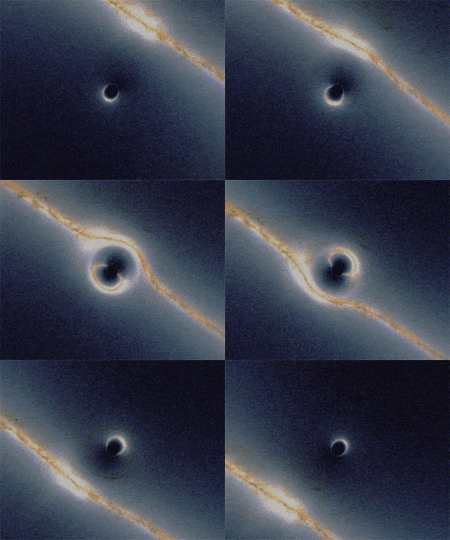
If we could move fast from say the southern pole of the black hole horizon toward the north pole (on Figure 1), we would observe about the same picture, as in the model above (Figure 2). The part of the accretion disk closer to us would look just like Saturn's rings, while the beyond horizon part would look like through the lens. So the difficulty to understand the shape of the disk is only due to the static state of the observer. If we could see it in dynamics, we would immediately recognize the phenomenon. Just watch the video!
https://www.youtube.com/watch?v=o-Psuz7u5OI
Moreover, the ability to see such images in dynamics also allows us to discover the new black holes and invisible massive bodies in the Universe. As soon as an astronomer notices that a whole sector of a previously familiar sky picture behaves somewhat weird like if seeing through a magnifying glass, e.g. some stars move up, others down, or even weirder: one star appears in several places (so called the Einstein cross), then this is a definite sign that an invisible very dark but massive object is moving between this familiar background picture and the observer. This unknown object distorts the background image. Recently, it was announced that in our slightly studied Solar system, presence of such an object was suspected somewhere behind Neptune. Thanks to the microlensing effect observed in this area (six events were counted), scientists suggested the presence of an exotic object that is still unidentified, and this could be either a large wandering planet or even primary black hole that formed from superdense matter at the time the expansion of the Universe began [What if Planet 9 is a Primordial Black Hole? Jakub Scholtz, James Unwin].
By the way, the effect of a cosmic lens was discovered by Einstein and was brilliantly proven during a solar eclipse at the beginning of the last century, when the light from a star passing near the Sun got deviated from its original direction flowing around the Sun, and the stars turned out to be visible not at the places, where they should be, but at a larger distance from the Sun.
So, observe the starry sky! It may be possible to notice the unusual behavior of the starry background and from this behavior you can discover new objects that have not been seen before. True, it would take a long time to discover that.
Also, if you have not seen the Interstellar movie, I highly recommend it. A group of scientists took part in its producing; and Kip Thorne even wrote a great book, The Science of Interstellar, where he described how they agreed to create images and visualizations that are as close as possible to what actually is known to science. Or at least they decided to use realistic scientific hypotheses. He explains the underlying science in details and yet simple enough for non-scientists. Therefore, to create a realistic image of a black hole or rather its surroundings, they used some real scientific working models; and the images were created accordingly to the latest scientific knowledge. And the recent real photo of a black hole proved it.

And finally, it is great to have an Internet and youtube, where we can find and enjoy so many great videos and visualizations!
youtu.be/_NgBE1pMRJM
First, imagine Saturn with its magnificent rings, and then imagine this Saturn turned black, and you cannot see the planet itself, but still can see the rings, and you get the picture. There are sparkling rings that circle around something we cannot actually observe, but it is there. The 'invisible' Saturn represents the event horizon of a black hole; we cannot see anything beyond this point. And the ring-like thin and hot shining structures formed of matter attracted by a black hole is so called an accretion disk. This disk is located on the equatorial plane as in any other galaxy formed around any massive celestial body. These rings are not calm rings made of ice chunks slowly circling around our well-familiar gas giant Saturn. This matter consists of highly energetic plasma that could be accelerated up to almost speed of light; it can be dense and heated if located close to the event horizon and it is more rarefied and slower moving at a distance. The accretion disk can also be visualized as a whirlpool, the very fast one.
There is a great NASA visualization that simulates the appearance of a black hole. (Figure 1)
https://www.nasa.gov/feature/goddard/2019/nasa-visualization-shows-a-black-hole-s-warped-world
However, as you can see in the picture, the accretion disk doesn't look like the Saturn rings. It is very deformed; it looks more like a weird emoticon without a face, but with a hat on. Some viewers have probably seen it in the Interstellar movie. Why do we see it this way? Because the space is very distorted, so the part of the ring, which is actually located behind this celestial body, would be seen partly over the top of the black hole horizon and partly below the bottom. So, the image is still like the rings of Saturn, as would be distorted in a curved mirror or rather seen through a strong convex lens or a clear glass sphere.
Yes, we get it; the space is distorted. But still… Do we? Why the disk has such a weird shape?
To understand the simplicity and beauty of this phenomenon, we need to understand the gravitational lens effect. Let's see the visualization. The image shows a computer model of the passage of a black hole. On the background, we can see the image of a distant galaxy. Note that the galaxy itself is not affected, it is far-far away, and nothing happens to it. Only its image is distorted. You can create alike effect using a strong convex lens or a glass sphere looking through to the image of the same galaxy or to any other image or geometric pattern. If you have such a lens or a glass sphere, then try it. This is the simplest experiment to help yourself to understand the phenomenon of gravitational lens, and you can do it at home. (Figure 2)
If we could move fast from say the southern pole of the black hole horizon toward the north pole (on Figure 1), we would observe about the same picture, as in the model above (Figure 2). The part of the accretion disk closer to us would look just like Saturn's rings, while the beyond horizon part would look like through the lens. So the difficulty to understand the shape of the disk is only due to the static state of the observer. If we could see it in dynamics, we would immediately recognize the phenomenon. Just watch the video!
https://www.youtube.com/watch?v=o-Psuz7u5OI
Moreover, the ability to see such images in dynamics also allows us to discover the new black holes and invisible massive bodies in the Universe. As soon as an astronomer notices that a whole sector of a previously familiar sky picture behaves somewhat weird like if seeing through a magnifying glass, e.g. some stars move up, others down, or even weirder: one star appears in several places (so called the Einstein cross), then this is a definite sign that an invisible very dark but massive object is moving between this familiar background picture and the observer. This unknown object distorts the background image. Recently, it was announced that in our slightly studied Solar system, presence of such an object was suspected somewhere behind Neptune. Thanks to the microlensing effect observed in this area (six events were counted), scientists suggested the presence of an exotic object that is still unidentified, and this could be either a large wandering planet or even primary black hole that formed from superdense matter at the time the expansion of the Universe began [What if Planet 9 is a Primordial Black Hole? Jakub Scholtz, James Unwin].
By the way, the effect of a cosmic lens was discovered by Einstein and was brilliantly proven during a solar eclipse at the beginning of the last century, when the light from a star passing near the Sun got deviated from its original direction flowing around the Sun, and the stars turned out to be visible not at the places, where they should be, but at a larger distance from the Sun.
So, observe the starry sky! It may be possible to notice the unusual behavior of the starry background and from this behavior you can discover new objects that have not been seen before. True, it would take a long time to discover that.
Also, if you have not seen the Interstellar movie, I highly recommend it. A group of scientists took part in its producing; and Kip Thorne even wrote a great book, The Science of Interstellar, where he described how they agreed to create images and visualizations that are as close as possible to what actually is known to science. Or at least they decided to use realistic scientific hypotheses. He explains the underlying science in details and yet simple enough for non-scientists. Therefore, to create a realistic image of a black hole or rather its surroundings, they used some real scientific working models; and the images were created accordingly to the latest scientific knowledge. And the recent real photo of a black hole proved it.
And finally, it is great to have an Internet and youtube, where we can find and enjoy so many great videos and visualizations!
youtu.be/_NgBE1pMRJM
![[community profile]](https://www.dreamwidth.org/img/silk/identity/community.png)